
Creativity: Divergent and convergent thinking necessary in course design
Table of Contents

The University Teacher Designers should master the indispensable yet old-fashioned skills for instructional design, as described by Dick and Carey (1993), Valcke (2007), Earl (1987), and Nedermeijer (2022, Chapter 6).
Below, I specify the additional skills of the teacher designer.
- Think-up the learning process for students.
- Formulate learning objectives and adapt them through progressive insight.
- Collect and structure the discipline’s subject matter to study in the course.
- Study the users’ perspective of the involved students and teachers, which might influence the course design.
- Gain insights into the pedagogical possibilities of learning methods and materials and understand how to create these materials.
- Understand and apply evidence-based (or informed) pedagogical options in new teaching-learning situations.
- Identify and describe the various elements of the learning environment, assessing their coherence, also known as constructive alignment.
- Follow the stages of the course design and development process.
Divergent and convergent thinking
- The Figure shows the alternation between divergent and convergent thinking during the Basic DD process. Divergent and convergent thinking are both essential aspects of course design.
- The divergent side creates possible new pedagogical options for your course design. At the same time, the convergence side makes choices about which ideas are most promising. Before finishing a design activity, ask yourself: Do my ideas fit my educational vision and learning objectives?
- Creativity and intuition are vital elements of divergent thinking in a design process. In other words, without creativity and intuition, your pDD process will end.

Your creative process can be enhanced
Creativity can be evoked in a structured and systematic way. On the one hand, you can somewhat structure the creative process to limit the scope of your thinking. On the other hand, there is no room for creativity when there are too many limitations.
Recognising a problem is not enough to come up with a solution and motivation is needed to tackle the problem and dive into it. Intrinsic motivation from within is especially desirable for achieving creative achievements. It would help if you felt the urge to find a solution to complete the design process.
All people can be creative; some may be more naturally inclined. Everyone can benefit from suggestions on how to be more creative. The Delft Design Guide, by Van Boeijen (2020) and Roozenkrans (2020), provides valuable tips for being creative, whether individually or in a group.
How to be creative and think divergent?
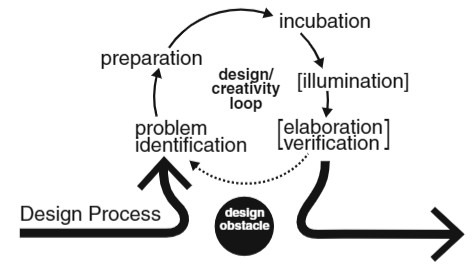
The course design and development process offers many situations where you need creativity. For example, you prepare learning objectives, ideas for route maps, assignments, learning materials and test questions. Clinton and Hokanson define the five stages in the creative process
-
- The creative process starts with designing a clear and detailed problem description. You need a clear and valuable design assignment. For this, you combine all relevant information into your problem description. This gives you the context for looking for possible solutions.
- The following design step is incubation. Place the problem and the context aside and allow them to simmer in your head. Some people will say I will sleep a night on it, while others will have a stroll or shower. Your brain can now structure the collected information in the subconscious mind.
- If you are lucky, you will have an Eureka moment that helps you solve the problem. This step is called illumination. Your new idea(s) is(are) now part of your DD process.
- You evaluate whether the thought-up ideas are workable solutions. If so, you have made a step toward the desired design. If unsatisfied, you might reformulate the problem and repeat the creative process.
-
Some tips from the literature to stimulate your creative process
-
- Look for a situation where the focus is not on your problem: go for a walk, take a nap, attend a party, or take a shower, for example. Creative thinking will go into the subconscious.
- Describe and organise your problem in a short document. What are your challenges? Your design obstacle(s)?
- Visualise your problem on the whiteboard, with small cards or paper. Look for new relations and ideas to make the problem and possible solutions visible.
- Try lateral thinking or thinking outside the box. Many technical problems have been solved by looking at animals or plants.
Check Edward de Bono (2023) for lateral thinking ideas. - Explain and discuss your problem with a trusted colleague. Often, you will find new connections and possible solutions.
- Colleagues can help you examine the problem from different angles or prompt you to verify the coherence and correctness of your ideas. Perhaps you didn’t consider the additional information.
- Organise a brainstorming or nominal group, or use Synectic to think and discuss your well-formulated problem. There should be an open atmosphere in the group. Mistakes by participants are not a problem, but rather a reason to think again. Sometimes, at first, it is necessary to make a problem diagnosis because the problem description offers the participants insufficient guidance;
- Follow the structured approach proposed by Scamper (2019) to think divergently. This approach employs seven heuristics to generate additional ideas: substitute, combine, modify, consider alternative uses, eliminate, and reverse.
- Stimulate your thinking with the help of analogies, metaphors or examples from other teachers. For example, technical designers search in the world of animals and plants for analogies. Many examples can inspire you in training and education.
- Another option to open your mind is to imagine the relationship of your design problem with a random word in your dictionary (one of the ideas by Edward de Bono (2023).
-

