
Table of Contents
5. Exercising practical application of the design features
This section focuses on the practical application of core design features in higher education courses.
By engaging in structured exercises, educators learn how to translate theoretical principles into concrete design decisions that shape meaningful learning experiences.
These activities support the development of skilled educators who can purposefully apply design features in real teaching contexts.

Website Blended Learning: more background articles (in maintenance)
Why this Blog
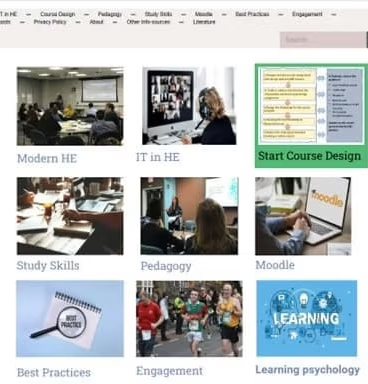
This BLOG is meant to support the teachers and the staff of Institutes of Higher Education by introducing different kinds of IT in their education. Over the past five years, I have volunteered for PUM Netherlands senior experts and SEC (Senior Expert Contact) Suisse. The educational institutes I worked for in Indonesia, Ghana, Nepal and Haiti were interested in modernising their education by introducing blended learning. I have prepared and organised courses and workshops in Blended Learning and Moodle for these institutes using my experience in Dutch Higher Education.
The main topics of the website:
- What is meant by modern higher education (MHE)?
- IT and blended learning are essential in MHE: What options are offered to the teachers by IT?
- The introduction of blended learning has consequences for teaching the teachers and the students’ study activities: What can be said about the pedagogical and study skills?
- If you want to redesign your course into a blended learning course, How can this be done?
- Moodle as the learning environment
- ‘How to ……’ and best practices descriptions.
Evidence-based options for how to apply IT in Higher Education

Blended Learning is a combination of online learning, F2F (face-to-face) sessions and self-study. The topics of this E-learning course are evidence-based options for applying IT in Blended Learning courses in Higher Education.
Why is there so much focus on Blended Learning?
IT offers many opportunities to enrich traditional education.
In the literature about Blended Learning, many evidence-based options about the use of IT in Blended Learning can be found.
In this e-course, an overview of possible IT pedagogy options is given, and some assignments are provided. In the coming period, I will add the specific AI pedagogical options. A first overview of the AI-options is given on the page.
As a teacher, you have certain expectations about the effects of using IT. It is you who decides which options you like to apply to make your course better. But… the IT options are based on research in specific educational contexts.
The crucial question is …. will the IT options you select have the expected effect in your course?
E-book ‘Evidence-based options as how to apply IT in Higher Education courses‘

As a teacher, one anticipates specific outcomes from integrating IT. The E-book provides an extensive survey of potential IT solutions for higher education. It encompasses detailed descriptions and includes tasks to aid the selection of advantageous IT alternatives.
Many blended learning options can be supported and strengthened by AI. Look here for a range of blended-learning AI options. Here you can find a series of AI.
What are your options for using IT in your course? The literature offers many evidence-based options for applying IT in higher education. However, these IT options are based on research in a specific context(s).
The main question in course design is, will the AI/IT options you select have the promised effect on your course?
Interactive assignment Modern Higher Education
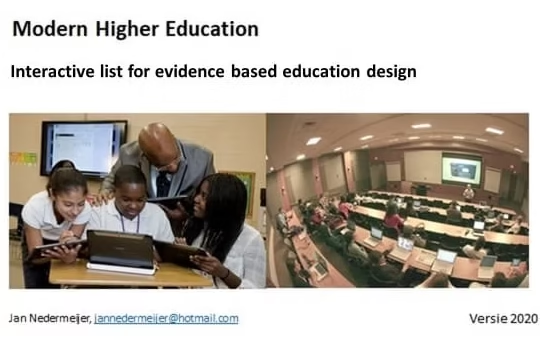
Many university teachers have been organising online education, which is being researched. Why not apply some of these newly developed and researched teaching and learning activities? How can you use IT and AI options in combination with F2F education?
The interactive assignment provides a list of evidence-based ideas for course design. The IT and AT Ideas have been explained more practically than in the research literature. The game is designed to help you select valuable ideas for your new course. The game results are that you have selected 5–7 ideas about modernising your education course and have formulated your expectations and requirements (see Nedermeijer, 2024, chapter 16)
The design and development of the game was a design assignment in the mooc Delft Design Approach (course code DDA691x2014). A fellow course participant, F. Sachs, realised the technical part of the game design.
Evidence-based suggestions on how to apply IT in Higher education courses
Lorem ipsum dolor sit amet, consectetur adipiscing elit. Ut elit tellus, luctus nec ullamcorper mattis, pulvinar dapibus leo.
You can try to follow a practical Moodle Workshop, applying the 6-step DD-process
The Learning objectives and the expected results of the workshop. The primary objectives of the course are to provide teachers with a realistic understanding of blended learning and to introduce them to the concept of blended learning in their courses.
More specifically, the teachers:
- Acquaint themselves with the principles of blended learning and the course (re)design and development process for introducing blended learning in their education.
- Have experience with using several pedagogical IT options and have discussed examples of blended learning activities as a group.
- Acquaint themselves with the design principles of Modern Higher Education.
- Redesign a small part of one of their courses into a blended learning course following the 8-stage course design and development process.
- Discuss the possibilities of using IT in their educational institute’s programmes and the requirements the university should fulfil to implement blended learning courses.

The pedagogical concept of the Moodle workshop
- The course assignments connect with the practice of the teachers where possible.
- Moodle supports the participants’ learning activities.
- The focus is on experiencing active learning. It is learning by doing. During the course, the participants study the IT options in Modern Higher Education ( (MHE).
- The subject matter is presented on the Moodle website MHEcourses.curriculumdesignhe.eu.
- Background information is available on this website ‘Design of Evidence-Based Blended Learning in Higher Education‘ and the book Design Blended Learning.
