
Pedagogical concept explains your perspective for your course or complete curriculum
Table of Contents
What is a pedagogical concept?
In the pedagogical concept of a course, the teacher designers (as a team) articulate their educational vision and the methods they intend to employ in their course.
A fundamental skill required of teacher designers is a thorough understanding of the design principles (DP) that underpin contemporary modern university education.
Teachers must not only grasp these principles but also integrate them effectively into their courses.
Furthermore, evaluating the usability and impact of these principles in their teaching context is essential for continuous improvement.
The pedagogical concept forms a core element of the course’s learning environment. It articulates the teacher’s or teaching team’s beliefs about student learning and development. This concept draws on educational research and teachers’ professional experiences.
In essence, the pedagogical concept serves as a crucial design tool, used alongside other elements of the learning environment.
The pedagogical design principles are integral to your course’s pedagogical concept. The corresponding teaching and learning methods and materials aligning with these principles are clearly outlined to benefit the teaching staff involved.

How to formulate a Pedagogical Concept?
Design activity 1: Prepare and discuss the design brief
|
Prepare a design brief or assignment to explain the course design task and the pDD process you like to follow to finish the design task. |
The target groups in my training programs and workshops were university teachers, managers and supporting (IT) staff. They were from different fields of expertise, such as health, teacher education, law and information technology. The number of participants in the training programs varied between 15 and 50. The number of participants in the workshop varied between five and eight teachers and IT staff. In addition to teacher training, most institutes organised a special 2–3-hour meeting for 30–300 students to inform them about the possibilities for using it in their education.
Education in the countries mentioned above is still strongly teacher-oriented. There is often little self-study beyond studying books for tests. Active learning, group work, self-study assignments, project work and other learning activities are not popular. Teachers are often hesitant to change their teaching. Team teaching is not popular. This situation is similar to that of university teachers in the Netherlands. The Indonesian Ministry of Education recommends these modern educational methods through official documents. Some young teachers have already used Virtual Learning Environmment in their university courses. A few teachers might be seriously interested in MUE. The IT staff provides minimal support for teachers in using pedagogical software and modern pedagogical approaches. Consequently, participants in the training programmes differed significantly in their teaching experience and knowledge of blended learning and MUE.

The pedagogical components that require special attention in the course are analysed in Stage 1 and 2 with the help of the serious game (mhe.curriculumhedesign.eu)

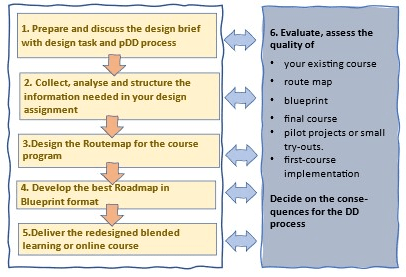
10.3 Design activity 2: Collect, analyse and structure the information needed in your design assignment
|
1. Make a systematic description of the vle, including the diamond diagram (Figure 9); 2. Draw the pedagogical concept with existing and new pedagogical measures; 3. Formulate the quality criteria you and the management set for the new course more precisely; 4. Explain the other points that you consider essential. |
10.3.1 ITedu tools, it options for universities and existing training materials
Not many texts in Dutch or English can be used in the workshop by copying and pasting their contents. However, these texts are very relevant. For example, the assignments used in teacher training programs of ICLON and E-merge. How can we acquaint teachers with it in education? How to learn using a virtual learning environment like Moodle? Other valuable exercises include using the internet safely and finding Open Educational Resources (OER).
The content must be adapted to the context in Indonesia, etc. The aforementioned finding necessitated the preparation of new learning materials. Some of these materials include:
- Examples of possible it uses in he are arranged into six main it pedagogical functions (Chapter 5);
- The matrix of educational functions versus it tools (see Chapter 5 Table 4);
- An overview of possible types of ITedu tools and examples (see Paragraph 6.9.6 Table 18). The overview with hyperlinks is available on the website Design Blended Learning and Online Education (Nedermeijer, 2023) and look for IT possibilities in Education?
- Some short manuals about using Moodle as students and teachers.
- The Game Modern Higher Education, with a systematic overview of evidence-based pedagogical options for MUE (see Chapter 16);
- A systematic description of the 9-stage pDD process (see Figure 7).
10.3.2 The diamond diagram for the ‘Workshop Blended Learning and Moodle.’
The results of the design activities regarding the collection, analysis, and structuring of information are systematically presented in the diamond diagram. When preparing the diamond diagram, you can check if its five elements described in Figure 10 have robust coherence (or constructive alignment). This is a crucial result of my pDD process.
|
TABLE 25 The diamond diagram for the workshop Blended learning |
|
Learning objectives and results After the introductory course, a workshop can be organised for a small group of teachers interested in obtaining more experience redesigning their blended learning courses. In principle, these teachers can support others in their redesign tasks. The goals of the follow-up course are as follows: 1. Support completing the redesign of one of their courses in a blended learning course; 2. Prepare a plan for the pilot project to implement their blended learning courses; 3. Explain the didactical possibilities of applying it and other DPs in he; The main results of the follow-up course were: 4. Several blended learning courses for the participants are available on Moodle; 5. The pilot projects were prepared and will be discussed with the management of the institutions of the teachers. The requirements to succeed in blended learning have been discussed and, where possible, realised; 6. The experiences and results of teachers in redesigning and developing an existing course can be used to help other University teachers design, develop and implement blended learning courses. |
Example 1 The Pedagogical concept of the Workshop Blended Learning and Moodle

Design idea 1: Theory and practice are combined
The Workshop on Blended Learning and Moodle should be similar to a typical university blended learning course. The participants should experience typical IT learning activities. The workshop combines F2F education, individual self-study and small group work.
The introduction of blended learning is often a reason to modernise education. This is why I have included elements of modern higher education (MHE) in the programme and workshop, e.g., active learning, test and (peer) feedback, interaction between participants and the trainer(s), and motivation of participants. These options follow the self-determination theory, which includes assignments with self-study, group discussions of relevant topics, and presentations by participants in the face-to-face classroom.
The participants will redesign one of their courses into a blended learning course. They will present the results of the training assignments in the Virtual Learning Environment (VLE), specifically Moodle. The teachers will select the IT options they prefer to apply in their course and explain their decisions. A helpful principle is that IT options should enhance the quality of the course for teachers by incorporating modern design principles, new IT tools, and assignments.
The learning products are prepared individually or in small groups and discussed in plenary sessions. The assignment results are regularly sent to the teachers’ trainer through Moodle. These assignments are evaluated and discussed in plenary sessions.
If this approach is followed, blended learning possibilities, VLE and MHE will not remain abstract ideas
Design idea 2: Learn to use Moodle
The learning activities of the participants are supported by Moodle, which also prepares training programmes and workshops. All participants should have permission to use the Moodle course as a teacher. The essential functions of Moodle are exercised in the ‘Introduction course’. Additionally, there is time to explore other Moodle functions in the workshop. For example, tests can be used to demonstrate progress and facilitate video calls with students.
Design idea 3: Specific focus on design activities
- Visualising the learning process, learning environment and other parts of the DD process in route maps, diamond diagrams and blueprints;
- Focusing on the DD process, the learning process and the learning environment. Including an explicit and robust emphasis on applying results from educational research;
- Weaving the stages of the basic technical design cycle into the DD process.
- Focusing on applying evidence-based it options;
- Formulating feasible course design tasks instead of giving general and abstract assignments. Try to prepare more concrete assignments and structure the activities of the participants.
- Stressing the need to describe better pedagogical models;
- Formulating and applying the quality criteria and requirements of the final result in the DD process.
Example 2: A pedagogical concept for a modern curriculum using the eight design principles

-
The eight design principles guide teaching teams in shaping their course concepts.
-
They help tailor pedagogy to fit modern higher education.
-
These principles support the development of course-specific teaching strategies.
-
Teaching teams can use the principles to design effective learning experiences.
-
The description helps educators align their courses with in their curriculum.
Design principle 1.Task-oriented learning/active learning
- Learning should be an active process, rather than just listening. Students must learn to use the content in authentic professional problems, cases, and issues. This will prepare them for lifelong learning. There is less theory and more skill training in nursing and midwives’ interventions.
- In the program, the teachers offer (connected) study assignments;
- The complexity and size of the assignments increase during the study years;
- There is transparency in the expectations towards the students. The courses are described clearly in the module books;
- Learning objectives and aims/competencies are logically related in and between the courses;
- Teachers and tutors support students in their self-study. During the study program, the students will have to study increasingly independently;
- The education will become increasingly focused on it. Students must learn to study using IT options.
Consequences:
- The students work on different study assignments related to the discipline;
- The assignments have clear learning objectives: the learning tasks, the expected results, the assessment criteria and the mode of discussing the results are clear and feasible;
- The assignments are presented through Moodle;
- The teacher gives the feedback, the tutor or fellow students (often through the vle);
- There is an optimal blend of F2F, online and self-study learning activities. The program stimulates the students to study regularly;
- In the assignment, the entry level of the students is taken into consideration. Remedial study materials are available through Moodle;
- For excellent and very motivated students, extra activities are possible.
Design principle 2.Issues and problems from the professional field are central.
- Knowledge is learned and applied in the context of professional issues and problems. It is possible to reduce the gap between education and the workforce. Competencies are based on the official curriculum planning and the university’s additional content and learning activities;
- Students are enabled to build a repertoire of solved patient cases. Students learn to solve health problems or tasks systematically;
- Also, students will be involved in innovative subjects or projects.
Consequences:
- Cases, problems or issues from the field are illustrated with the help of different media (pictures, video, simulations, and animation in Moodle);
- Cases are studied in the classroom, small workgroups, practical work in the skills lab, projects and internships. The learning activities are growing in complexity and difficulty;
- The teachers prepare their lessons. The pedagogical approach is theory – video, demonstration, and practice;
- Students learn systematically to analyse a client’s problem, issue or question. Possible methods: problem-based education, project education, case method;
- They learn to use the internet, books and articles to understand and use evidence-based methods to solve practical problems and experience organising an innovation project;
- The internships (both short and long) are systematically integrated into the regular study program. The students’ experiences are discussed.
Design principle 3. Explicitly focuses on knowledge.
- Students study knowledge through active learning methods like assignments, problem-based projects, internships and case study methods through online discussion, peer feedback and group discussion;
- Students will, during their study, enlarge, deepen and structure the knowledge they gained;
- A MOOC could be an essential source of up-to-date knowledge.
Consequences:
- Students study the main topics, concepts and developments relevant to the professional field;
- Moodle indicates the learning objectives, relevant knowledge, literature, books, websites and videos to be studied.;
- After the self-study, project work, and practical work, the subject matter is discussed, applied, and deepened during classroom meetings.
Design principle 4. Principle Learning tracks support the learning process in the program.
- The teachers and management should agree on the various learning tracks in the study program. In a learning track, the students learn to master the competencies;
- Competencies are acquired step by step in professional situations of increasing complexity. The course content and skills are presented in Moodle and the books;
- The development of students is described using rubrics.
- All courses build on previous courses and prepare for the following courses;
- Students develop themselves first as students and then as professionals.
Consequences:
- The teachers formulate the learning objectives, rubrics for each study year, and the subjects and activities for the various learning tracks. The teacher decides on the contribution of the relevant courses;
- When designing the course, the teacher ensures the correct learning objectives, course content and (sub) competencies can be studied and exercised;
- The teacher ensures that the course fits into the learning tracks in the program;
- The student’s progress is monitored and discussed through a portfolio.
Design principle 5. Collaborative learning/learning from fellow students
- Social bonding is essential to keeping the students committed, active and on track;
- The students learn from each other by verbalising and exchanging their knowledge, insights and approaches;
- Students must learn to collaborate with other professionals and clients.
Consequences
- Organise group activities that bring shared success to the students;
- Use the power of collaborative work in the F2F activities by organising small groups and using peer feedback;
- Social and professional integration can be achieved by organising a student club, mentor groups, and the easy availability of teachers through Moodle, a discussion forum, chat, and other social media.
Design principle 6. Testing and feedback are the motors of students’ learning.
Testing has three crucial functions:
- The tests’ content and format strongly influence the students’ study behaviour;
- With the testing, the faculty guarantees that students can function at the desired level of competency;
- The students (faculty and teachers) receive feedback about the study results and progress.
Consequences:
- The test format, content and criteria are transparent and connected with the learning objectives and activities.;
- There are both summative and formative (or diagnostic) tests, primarily administered through the VLE. For example, students prepare a portfolio to reflect on their ‘professional’ progress;
- Students’ knowledge is tested during and after the course through the vle and in the classroom.
Design principle 7. IT is a must!
- Improve the accessibility of available information for the students. New possibilities to present content, assignments, multimedia and up-to-date learning material should stimulate the students’ independent work;
- Preparation for the future. Almost all professionals work with digital hardware and software; not using it is not an option. Also, many students expect it in their education;
- With it, students can get more control (and responsibility) over their study activities. This is a crucial element of modern higher education.
- The students should learn to use ITedu tools and professional software and hardware effectively and efficiently in their studies;
- It supports students when a teacher is not available, but they need it.
Consequences:
- Ensure that ITedu tools work correctly;
- Offer extra explanations of complicated subjects;
- Encourage students and teachers to engage in interaction during the course.
- Provide more feedback through it;
- Facilitate students’ use of the internet, books, and articles.
Design principle 8. Possibilities for personal development.
- Most students have to learn to plan their studies, study texts (written and digital), learn from video presentations, work systematically and learn with all kinds of software and hardware;
- The primary feature of modern higher education is the increased responsibility of students for their studies. The teachers’ support and assignments decrease during the program (curriculum) (= scaffolding);
- During their studies, students require support in selecting their educational and professional paths. Students are supported in formulating their interests and plans and deciding on electives.
Consequences
- Support the start of the courses;
- Match prospective students to the course program.

